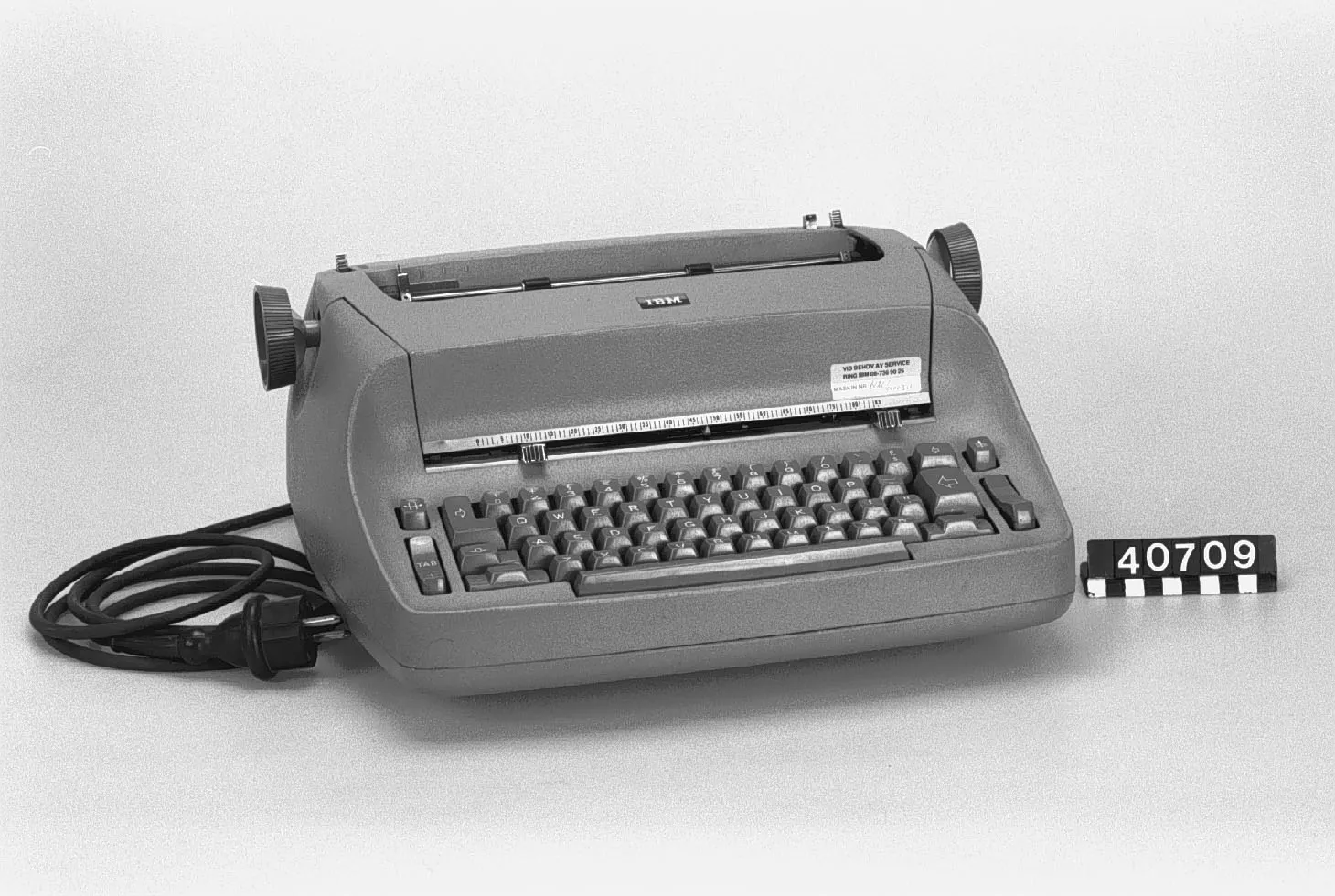
IBM Selectric I, launched July 31, 1961. Photo by Nils Salander, CC BY 4.0, via Wikimedia Commons.
.jpg)
A 1961 typing pool, 9:14 in the morning
Picture a Manhattan insurance office, late summer 1961. Twenty-eight women at twenty-eight desks, each pounding a mechanical typewriter at the maximum speed her wrists can sustain. The room sounds like a hailstorm on a tin roof. Every few minutes someone curses under her breath: two typebars have crossed in mid-air, locked together a centimetre above the page, and now she has to stop, untangle them, and erase the smudged double-strike with a gritty pencil eraser that takes a layer of paper with it.
This is the most affecting pain point in white-collar work. Carbon copies are how contracts, invoices, memos and policies move through the economy, and the typewriter is the bottleneck. By some industry estimates the United States produced around 800 million typed pages per working day in 1960. Every collision is friction at the centre of capitalism.
Then IBM walks in with a machine that has no typebars at all.
The pain the industry could not solve
The IBM Selectric was a line of electric typewriters introduced by IBM on July 31, 1961, and produced under the Selectric name until the early 1980s. To understand why it landed like a small earthquake, you have to understand exactly what it killed.
A traditional typewriter relies on a basket of around 44 individual typebars, one per character. Each keystroke swings a bar up to strike a ribbon against the paper. Type fast enough and two bars try to occupy the same airspace at the same instant — they collide, lock, and stop the line. Skilled typists hit a hard ceiling around 60 to 80 words per minute not because of their fingers but because of the geometry of the mechanism.
The pain stack went deeper than jams:
- No font flexibility. Each typewriter shipped with one face. Want italic, a different size, a math symbol? Buy another machine.
- Messy ribbon handling. Re-spooling, smudging, fading half-way through a long contract.
- Slow corrections. Erasers chewed up the paper. Carbon copies underneath turned every mistake into three smudges.
- Carriage that had to fly. The whole paper assembly travelled across the desk on every line, vibrating files off the table and limiting practical desk size.
Royal, Underwood, Olympia and Smith Corona had spent fifty years polishing this design. None of them broke the geometry. IBM did.
The engineering breakthrough: one ball, no bars
The Selectric replaced the entire typebar basket with a single rotating spherical element about the size of a golf ball. The ball — officially the typing element, universally called the typeball or “golf ball” — carried 88 characters on its surface. On every keystroke a mechanism tilted and rotated the ball to present the right character, then snapped it forward against the ribbon. The carriage stayed still; the ball travelled.
It is hard to overstate how much this single mechanical decision unlocked.
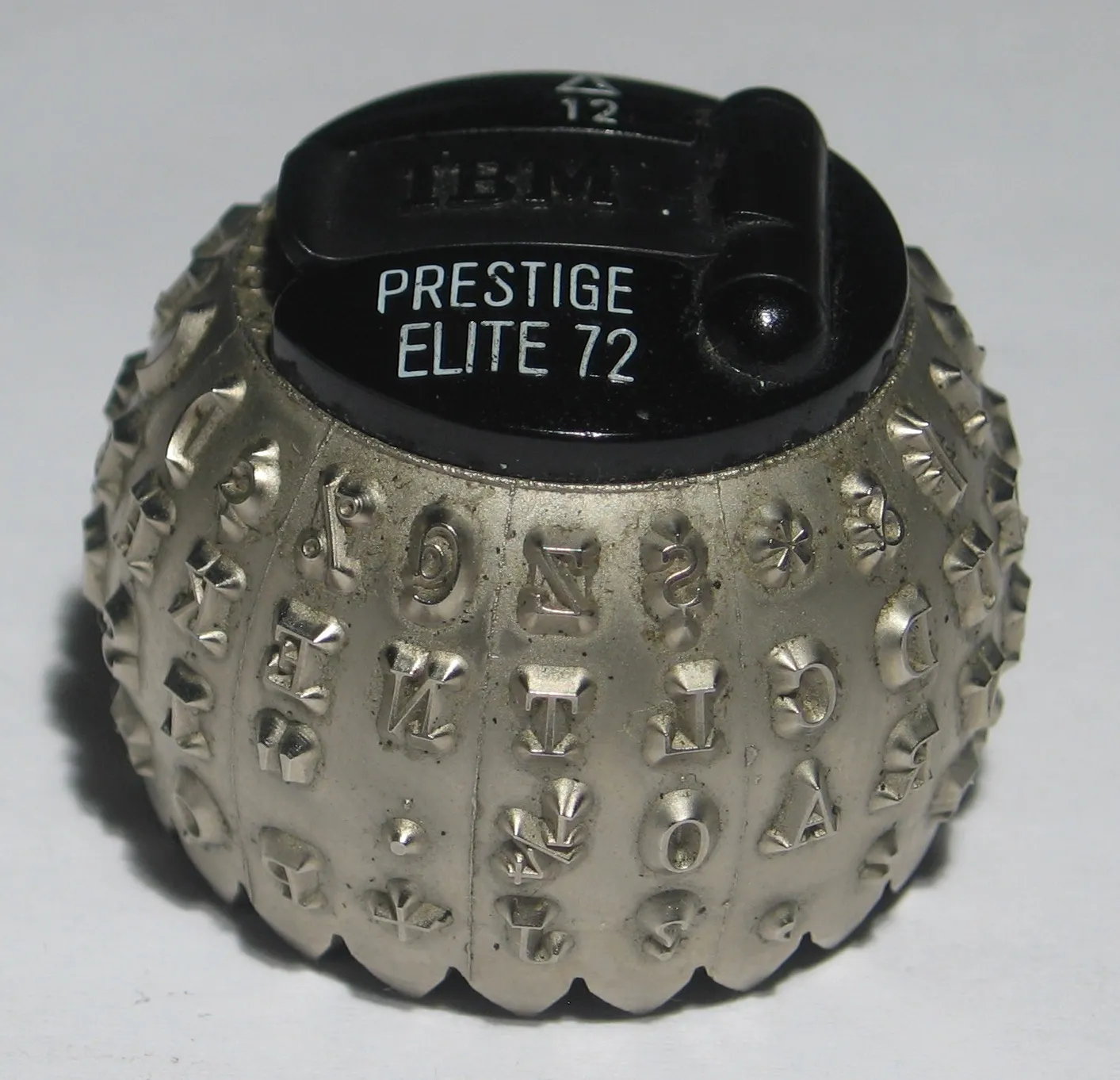
The typeball: 88 characters on a single rotating element. Photo by Scs, public domain, via Wikimedia Commons.

No more jams. With one element, two characters can no longer collide. Typists pushed past 90 words per minute on the same equipment.
Swappable fonts in seconds. Lift the lever, pull the ball off, drop a new one in. Suddenly the same machine could type Courier, Letter Gothic, Prestige Elite, Symbol, even custom proportional faces. IBM eventually offered hundreds of typeballs. For technical and scientific writing this was transformative — engineers could type Greek letters and equations without retro-fitting hardware.
Half-spacing and proportional layout. The Selectric’s escapement allowed half-character increments, opening the door to proportional spacing in later models — a step toward typeset-quality output from a typewriter.
A self-correcting ribbon (1973). The Correcting Selectric II added a sticky lift-off ribbon that pulled mistyped characters cleanly off the page. The pencil eraser became a museum piece.
The Selectric also introduced a quieter revolution: it became the first practical computer terminal interface for many early systems. The IBM 2741 terminal — a Selectric mechanism wired to a mainframe — was one of the standard ways scientists and engineers talked to computers in the 1960s and early 1970s. The same product that solved the secretary’s pain also helped seed the workflows that would eventually destroy it.
Product-market fit at industrial scale
The Selectric was not just a clever object. It was a category-defining product that captured a market with extraordinary completeness.
By the mid-1970s the Selectric line held an estimated 75% of the U.S. electric typewriter market for business use. IBM produced more than 13 million Selectric units over its production run. At its peak the typewriter division generated roughly $1 billion per year in revenue — a single product line larger than most Fortune 500 companies.
Three reinforcing flywheels kept it there:
- Switching cost lock-in. Once an office standardised on Selectric typeballs, every secretary’s font library was an asset stranded on IBM’s platform.
- Service network. IBM rented Selectrics under long maintenance contracts. The local IBM technician was a fixture in offices the way Xerox’s was for copiers.
- Brand certainty. “Nobody got fired for buying IBM” was first said about typewriters before it was said about mainframes. A purchasing manager choosing Selectric over Royal was choosing the safe option.
The Selectric hit the four conditions every PM dreams of simultaneously: a real, frequent, costly pain point; a 10× better solution; a defensible moat; and a buyer (the office manager) different from the user (the secretary), which insulated the product from end-user friction.
It should have been permanent.
The quiet shift underneath
The IBM Selectric did not lose to a better typewriter. It lost to a category that did not exist when it launched.
While IBM iterated on the Selectric II (1971), the Correcting Selectric (1973) and the Selectric III (1980) — each a meaningful refinement of a winning product — a completely different industry was assembling the parts of its replacement. None of those parts looked like a competitor. Most of them looked like office curiosities.
- 1976: Wang 1200. Wang Laboratories shipped a dedicated word processor with a CRT screen. You could see the page before printing. You could insert a sentence in the middle of a paragraph without retyping the rest. For a Selectric user this was magic.
- 1979: VisiCalc. The first spreadsheet. Suddenly the Apple II in the corner of the office was not a toy — it was a tool finance teams demanded.
- 1981: IBM PC. IBM’s own personal computer division, working in Boca Raton with deliberate independence from the typewriter people in Lexington, shipped the machine that would eat its sibling product.
- 1982: WordPerfect. A polished word-processing application running on the IBM PC and its clones. Bought once, used on any document, on any printer.
- 1984: HP LaserJet. Crisp, fast, quiet text on plain paper at 300 dpi. Carbon ribbons started looking medieval.
- 1990: Windows 3.0. The PC was no longer a specialist’s tool. Everyone could use it. Everyone was about to.
For most of the 1970s, IBM’s Selectric team could look at the computing column and reasonably say: that is a different market. Computers were expensive, complicated, and aimed at engineers. Typewriters were cheap, simple, and aimed at offices. Different buyer, different need, different sales motion.
That was true. Until it wasn’t.
By 1985 a personal computer with WordPerfect and a daisy-wheel or laser printer cost roughly the same as a top-of-line Selectric, did everything the Selectric did, and added screen-based editing, save-and-edit, search-and-replace, mail merge, and unlimited document storage on a 5.25-inch floppy. The pain hadn’t changed. The buyer hadn’t changed. Only the answer had.
The collapse: the pain migrated, the product didn’t
The decline was startlingly fast for a product that had owned its category for a quarter-century. Selectric sales held through the early 1980s, then began the kind of fall that does not have a recovery.
In 1991, IBM divested its entire typewriter and keyboard business as a new company called Lexmark International. It was the formal acknowledgement that one of IBM’s most profitable consumer-facing products had become a non-strategic asset to be spun out and recovered into cash. Lexmark continued making Selectric-style typewriters into the late 1990s for niche markets — court reporters, prisons, government forms — but the corporate offices that had defined the product were gone.
What disappeared was not the pain. People still needed to produce professional documents at speed. The pain was as real in 1995 as it had been in 1961. It just lived in a completely different product category.
This is the part of the story product builders most often miss. We talk about disruption as if competitors arrive in our market and outperform us. The Selectric had no such competitor. No typewriter ever beat it. The pain it solved simply walked out of the typewriter aisle and into the personal computer aisle, and the team that owned the pain in 1961 was no longer in the room when it was being solved in 1985.
| Era | Dominant product | What it cost | What it did |
|---|---|---|---|
| Pre-1961 | Mechanical typewriter (Royal, Underwood) | ~$200 | Fixed font, jams, manual carriage |
| 1961–1980 | IBM Selectric | ~$500–$1,200 | Swappable fonts, no jams, self-correcting |
| 1976–1985 | Dedicated word processor (Wang, IBM Displaywriter) | ~$5,000–$15,000 | Edit before print, store documents |
| 1981–today | PC + word-processing software + printer | ~$2,000 (1985), falling | Edit, store, search, share, reprint, format |
A Selectric salesperson in 1980 could honestly tell a customer: “Wang is too expensive, the IBM PC isn’t a typewriter, and laser printers are for graphic designers.” Each point was true in isolation. The combined force of the three was lethal.
The lesson: market awareness is a product discipline
The Selectric is the cleanest case study I know of a product team executing flawlessly on the wrong question.
- Solving the right problem brilliantly is necessary but not sufficient. The pain that funded your business can migrate to a completely different category — and your engineering excellence won’t follow it.
- Scanning the market for category-level shifts is a product muscle, not a once-a-year strategy exercise. The shift that kills you usually doesn’t look like a competitor when it’s small.
Three principles I take from the Selectric story when working on products today:
1. The better your product, the harder it is to see the shift
Engineering excellence creates inertia. Every Selectric refinement worked. The Selectric III was, on its own terms, a better typewriter than the Selectric I. The team had decades of evidence that “make the typewriter better” was the correct strategy. That evidence pattern-matched perfectly until the day it didn’t. (This is the same System 1 pattern-matching trap that catches PMs interpreting their own metrics — past wins train the brain to read the next signal the wrong way.)
The same trap is everywhere now. The team building the world’s best on-prem business intelligence dashboard in 2014 was getting more correct, more polished, and more wrong every quarter as the buyer migrated to cloud-native tools. The team building the world’s best Flash interactive in 2009. The team building the world’s best Foursquare-style check-in app in 2012. Excellence inside a doomed category is camouflage.
2. Watch the categories, not just the competitors
The IBM PC didn’t show up in the Selectric team’s competitive intelligence reports because it wasn’t a typewriter. Wang’s word processor showed up briefly but was dismissed because it cost ten times as much. By the time the threats looked like competition — by the time PC + WordPerfect + LaserJet was a natural bundle the secretary’s manager could buy — it was too late to pivot a 30-year-old electromechanical product line.
A useful question to ask quarterly: what tools is our user reaching for that don’t compete with us yet, but solve some adjacent slice of our pain? The honest answer is the early-warning signal. (See Statistical Significance vs Behavioral Significance for how this same blind spot shows up in metrics interpretation.)
3. Cannibalise yourself before someone else does
The most painful detail of the Selectric story is that IBM itself shipped the IBM PC in 1981 — the product that would eventually eclipse its own typewriter division. Within IBM, Boca Raton built the PC with deliberate independence from Lexington’s typewriter people. The company saved itself at a corporate level by having a team free to pursue the new category, but the typewriter division was not invited to the saving.
Every product organisation that owns a winning category needs an internal team whose job is to take the new category seriously — to be the people inside who would build the thing that puts the current product out of business. If that team doesn’t exist inside, it exists outside, and you don’t get to choose when it ships.
What this means for you, this quarter
If you ship a product, ask yourself, honestly, on a single page:
- What is the underlying pain my product solves? (Strip away the implementation. Name the human need.)
- What other tools is my user using to attack that same pain? Even partially, even badly?
- Of those tools, which ones got 2× better in the last 24 months?
- If a brand-new buyer were solving this pain from scratch today, with no existing relationship to my product, what would they buy?
If the honest answer to question four isn’t your product, you are the Selectric team in 1980. You still have time. You also still have the option of ignoring the question. The Selectric team did. So did Kodak with film, Nokia with hardware keyboards, Blockbuster with stores. The pattern is older than software and is not going away.
The lesson is not that great engineering doesn’t matter. The Selectric is one of the most beautiful pieces of consumer mechanical engineering of the twentieth century, and for 25 years it was both a great product and a great business. The lesson is that the question “is this still the right product?” has to be asked at the same cadence as the question “is this product still excellent?” — and most teams only ask the second one.
The market changes whether you watch it or not. The only question is whether you know what it is doing in time to do something about it.
Further reading
- Engineering Foundations of Generative AI: From Rules to Probabilities — another case where a category quietly replaced its predecessor while the incumbent kept refining the wrong thing.
- From Finite Elements to Human Elements — why an engineering background is a useful but dangerous tool for product work.
- IBM Archives: Selectric Typewriter — IBM’s own historical record.
- Computer History Museum: Selectric I — the museum entry for the original 1961 model.
Frequently asked questions
What was the IBM Selectric?
The IBM Selectric was a line of electric typewriters introduced by IBM on July 31, 1961. Its defining feature was a single rotating spherical typing element — the typeball, often called the “golf ball” — that replaced the basket of 44 individual typebars used in earlier typewriters. The Selectric eliminated typebar jams, allowed swappable fonts, and became the dominant electric typewriter for business use through the 1970s and early 1980s.
Why did the IBM Selectric become obsolete?
The Selectric was not displaced by a better typewriter. It was displaced by an entirely different product category: the personal computer paired with word-processing software and a printer. Beginning around 1976 with dedicated word processors and accelerating after the IBM PC launched in 1981, the same buyers who had bought Selectrics began buying PCs running WordPerfect, MultiMate or WordStar with daisy-wheel or laser printers. By the late 1980s the PC bundle did everything the Selectric did and added screen-based editing, document storage, search-and-replace and reprintability.
When was the IBM Selectric discontinued?
IBM divested its entire typewriter and keyboard business as a new company called Lexmark International in 1991, which marked the effective end of the Selectric as an IBM product. Lexmark continued producing Selectric-style typewriters for niche markets — court reporters, government offices, prisons — into the late 1990s, but the product line had exited the mainstream office market by the early 1990s.
What can product managers learn from the IBM Selectric?
The IBM Selectric is a textbook case that solving the right problem brilliantly does not protect you from category-level market shifts. The Selectric team executed flawlessly for 25 years, dominated their market, and were eventually rendered redundant by a product category — the personal computer — that was not on their competitive radar when it was small. The lesson is that scanning the market for category shifts is a product discipline, not a strategy meeting; that engineering excellence creates inertia which makes shifts harder to see; and that organisations should fund the team that would put their winning product out of business, before someone outside does.